Product | Disputes and Fraud Management

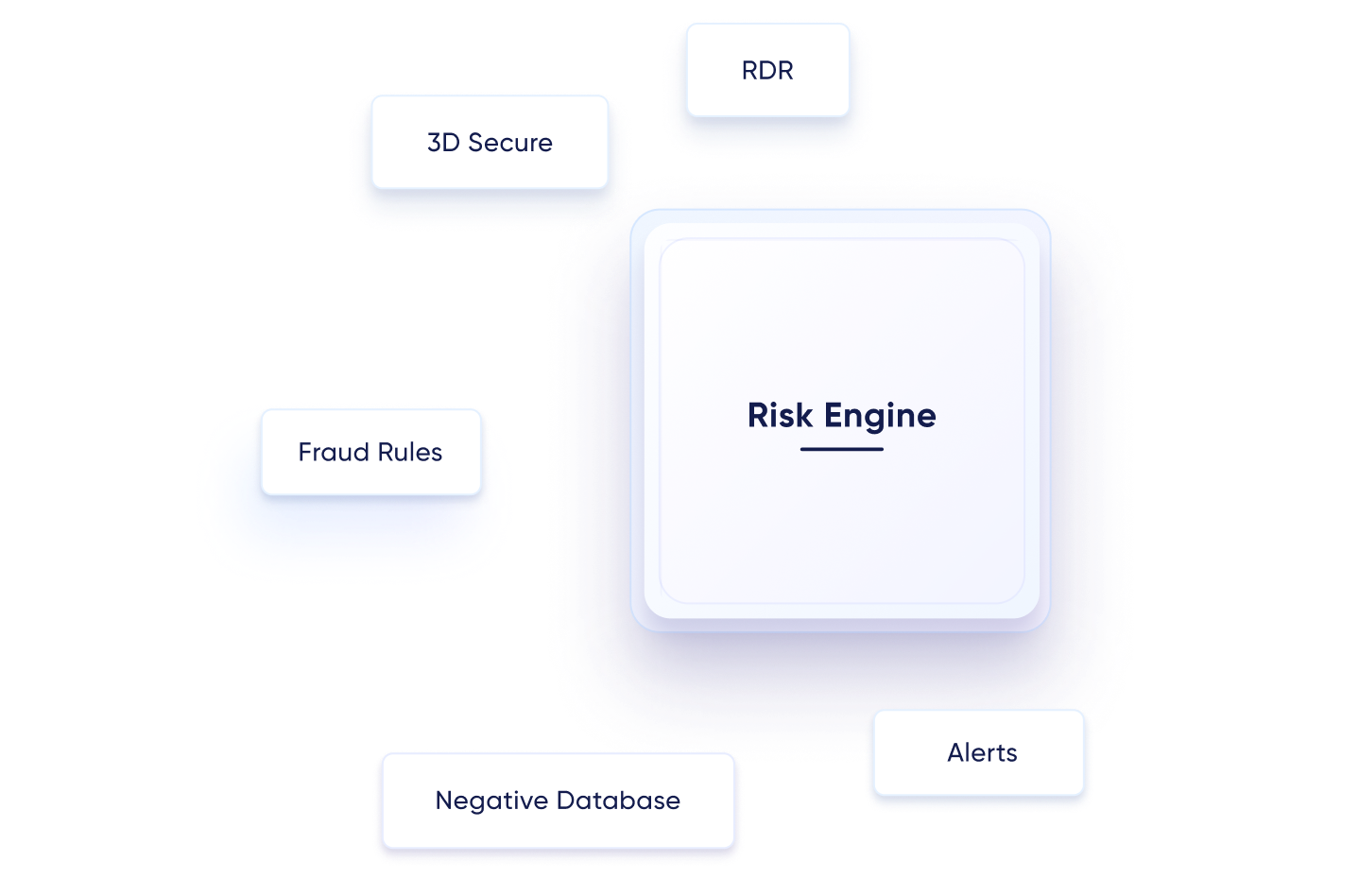
UpGate Risk Engine — Fraud Prevention at the Orchestration Layer

UpGate provides a single, consistent fraud evaluation layer before a transaction is routed to any payment processor. This eliminates fragmented risk logic, inconsistent decline patterns and the ability for fraudsters to bypass controls by switching processors.

All fraud rules, alerts, and actions are evaluated centrally — ensuring predictable protection and eliminating gaps caused by processor-level logic

Get started
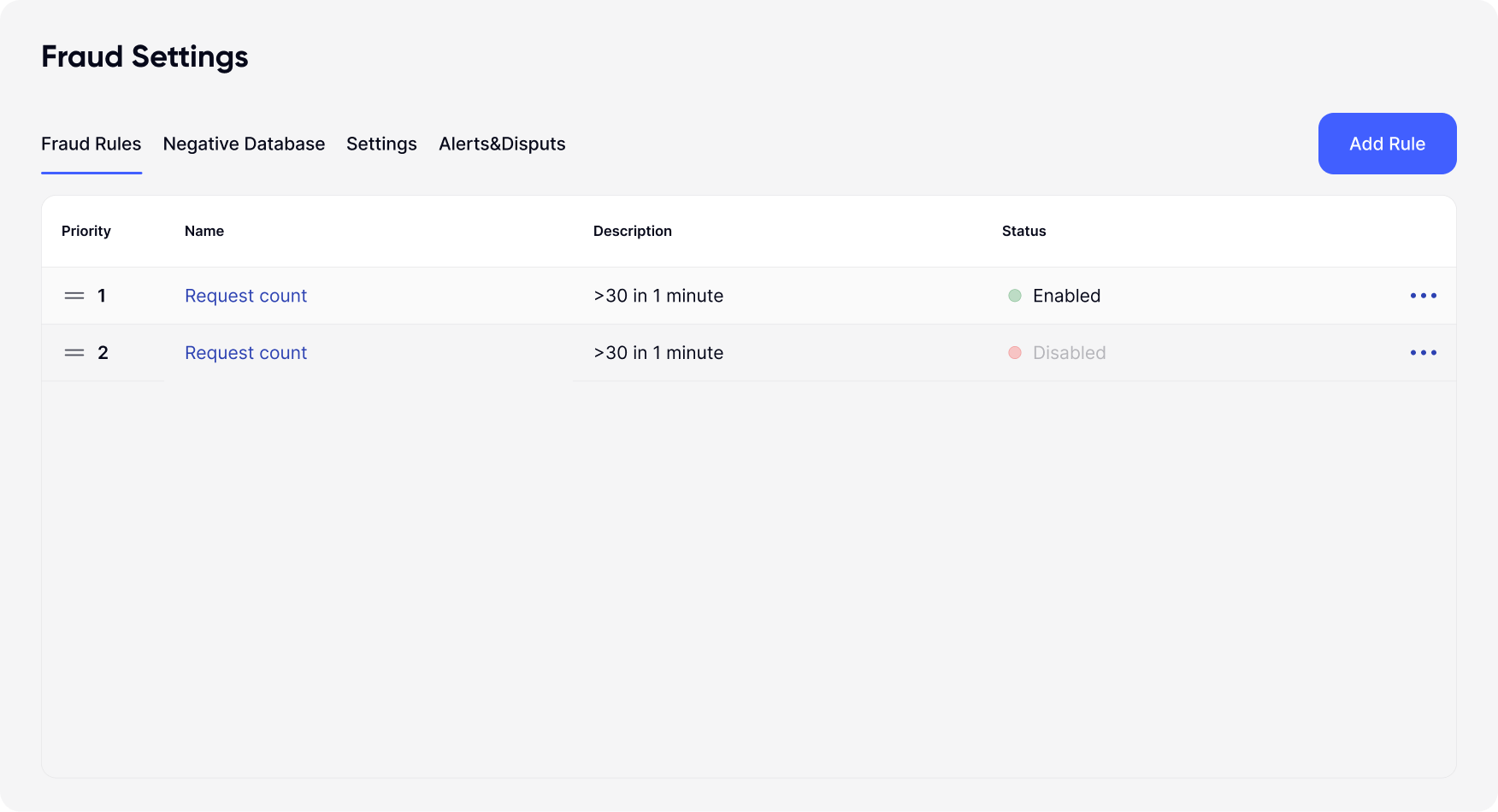
Fraud Rule Engine

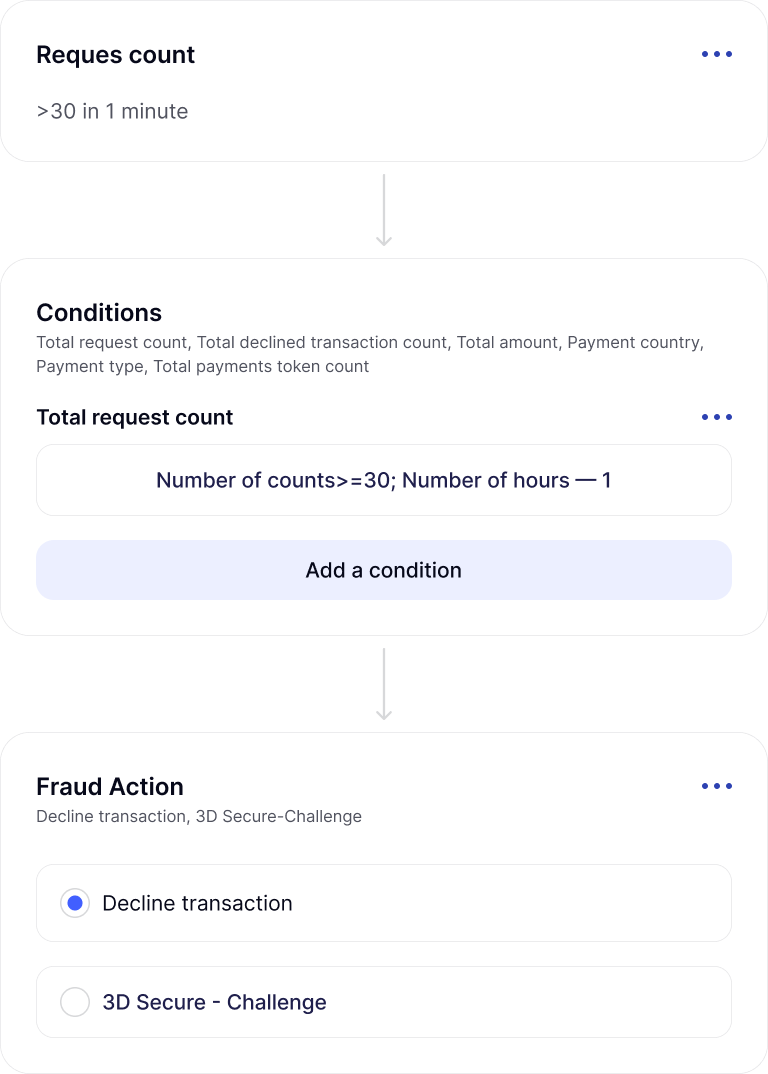
The Fraud Rule Engine allows merchants to define their own conditions for detecting and preventing risky transactions

Rules are evaluated before payment, guaranteeing uniform enforcement across all processors

Merchants can build rules using

  • Transaction parameters: country, BIN range, amount, payment type
  • Identity indicators: IP address, email domain, Customer ID
  • Velocity and event frequency: repeated use of the same token, card, IP, or email within a defined timeframe

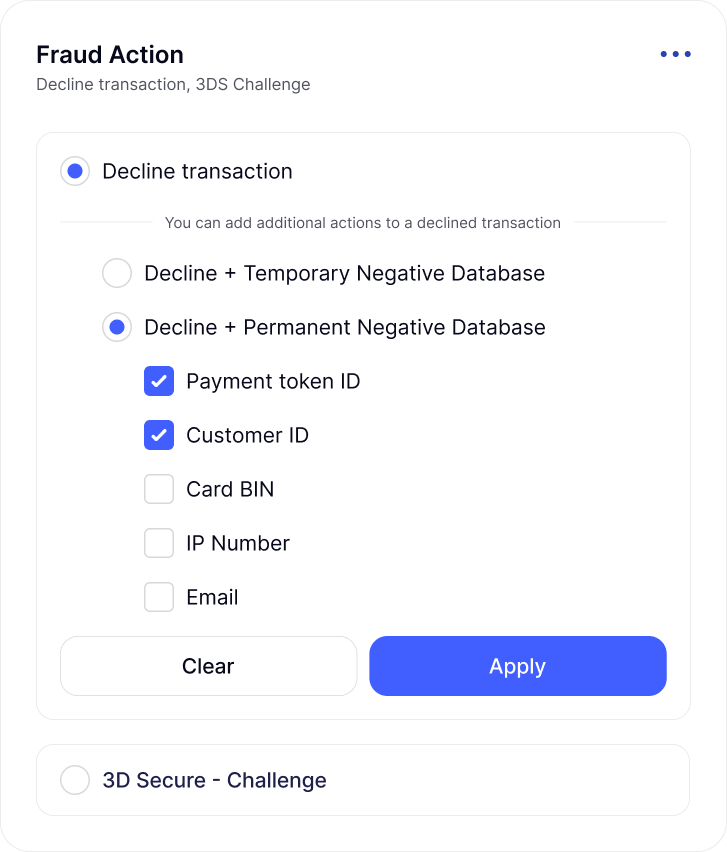
When a rule is triggered, UpGate can

  • Decline the transaction
  • Force 3DS Challenge for additional verification

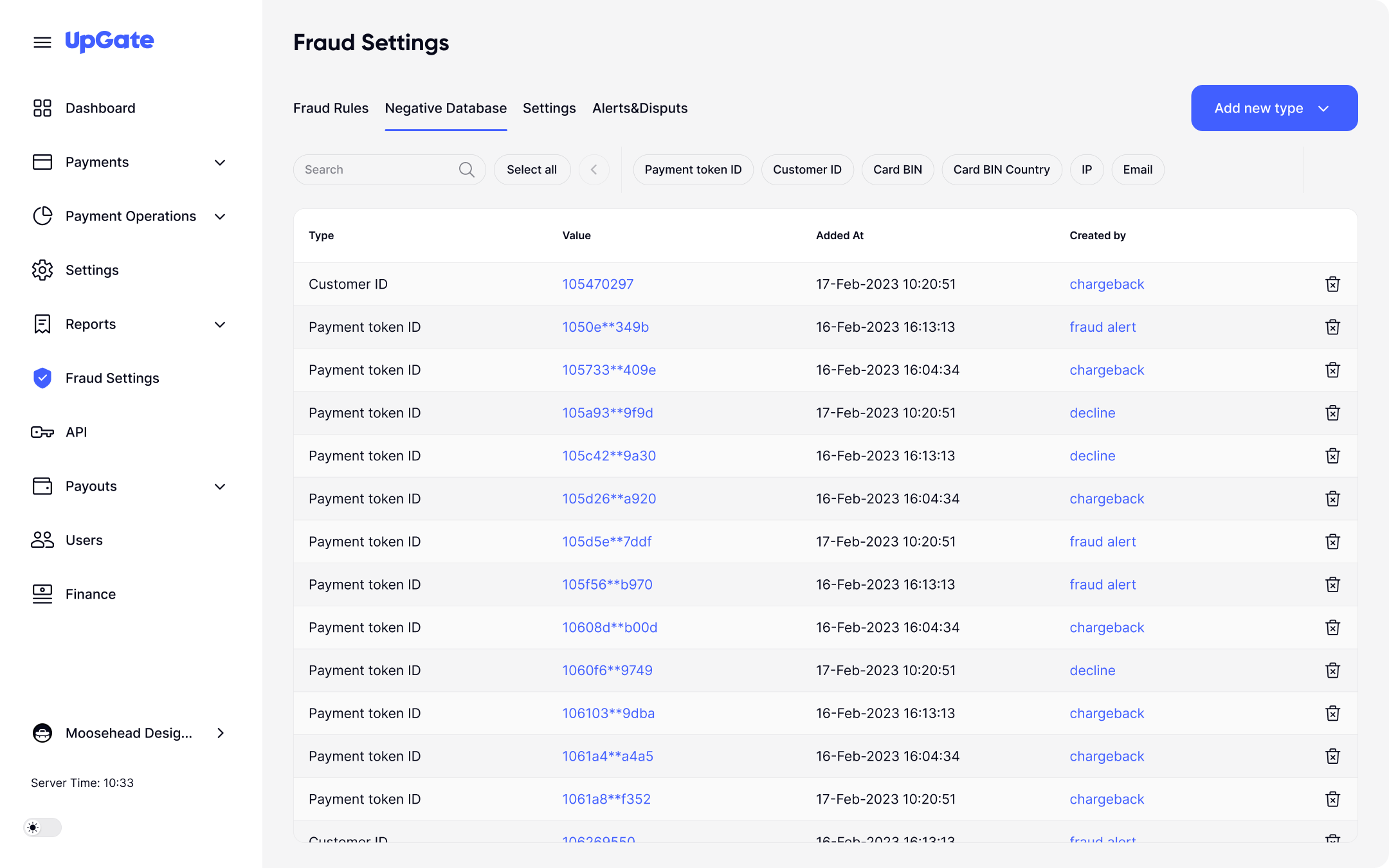
Negative Database

The Negative Database (ND) is a merchant-owned, centralized repository of high-risk identifiers

Once an identifier is added, it is blocked across all processors — preventing fraudsters from retrying via alternative routing paths

identifier types

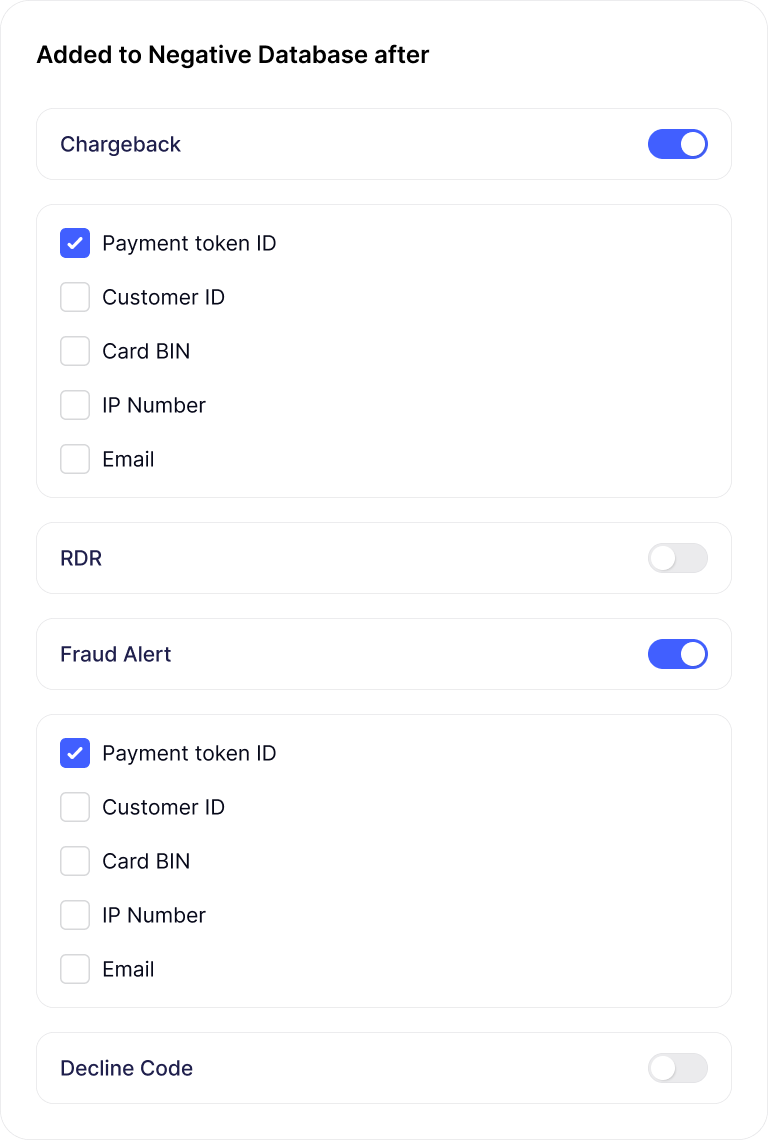
Values can be added manually, through rule outcomes, or via incoming alerts

The Negative Database can store

  • Payment token IDs
  • Customer IDs
  • IP addresses
  • Email addresses
  • BIN or card metadata

Processor Fraud Alerts

This extends a local processor signal into merchant-wide enforcement

UpGate ingests fraud-related alerts from individual processors (where supported), such as

  • Issuer-suspected fraud notifications
  • Processor-generated risk flags
  • Abnormal transaction markers

Although these alerts originate from a single processor, UpGate enables global actions, including

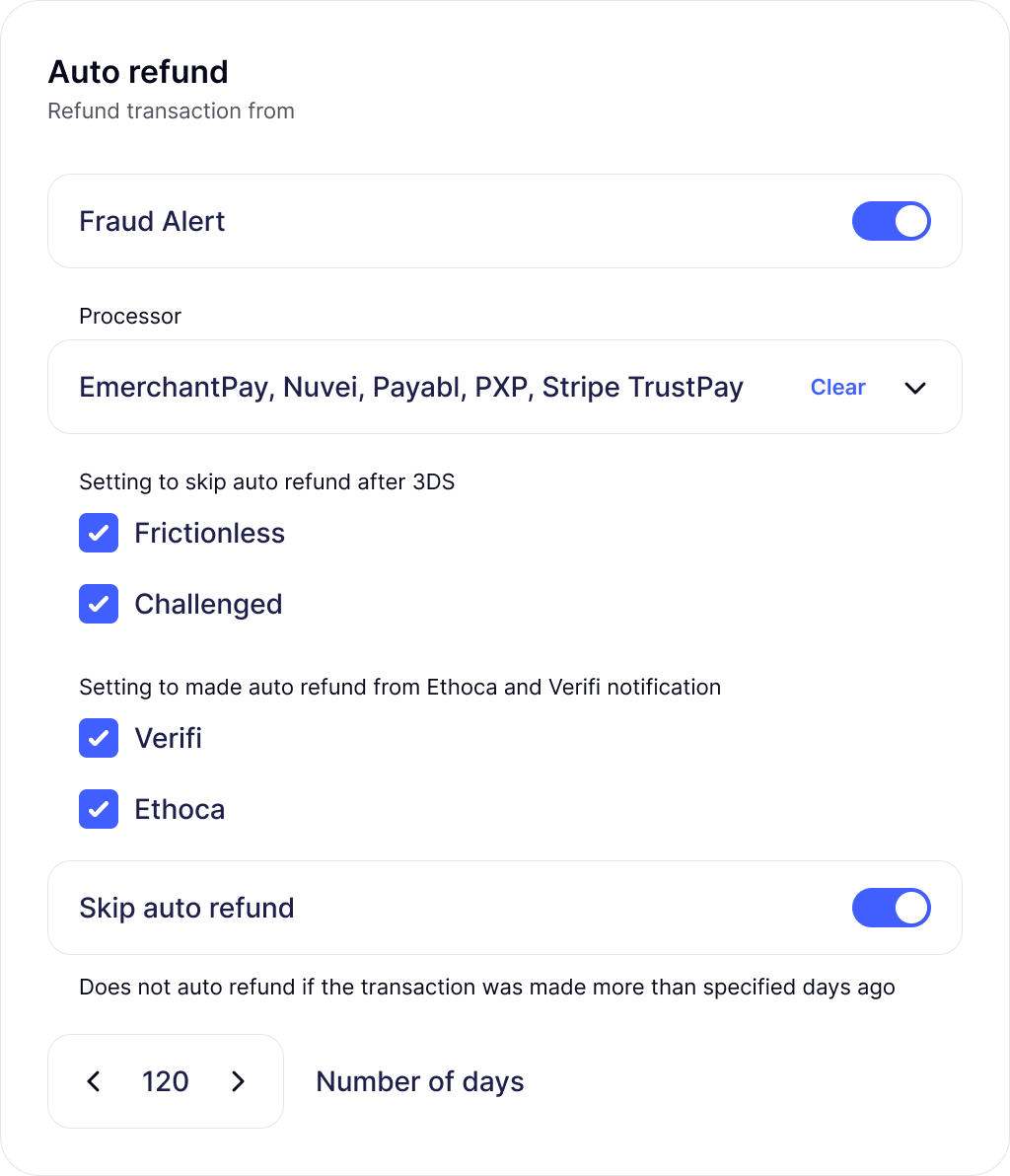
  • Automatic refunds
  • Adding identifiers to the Negative Database
  • Blocking repeated attempts

Scheme Fraud Alerts (Visa/Mastercard)

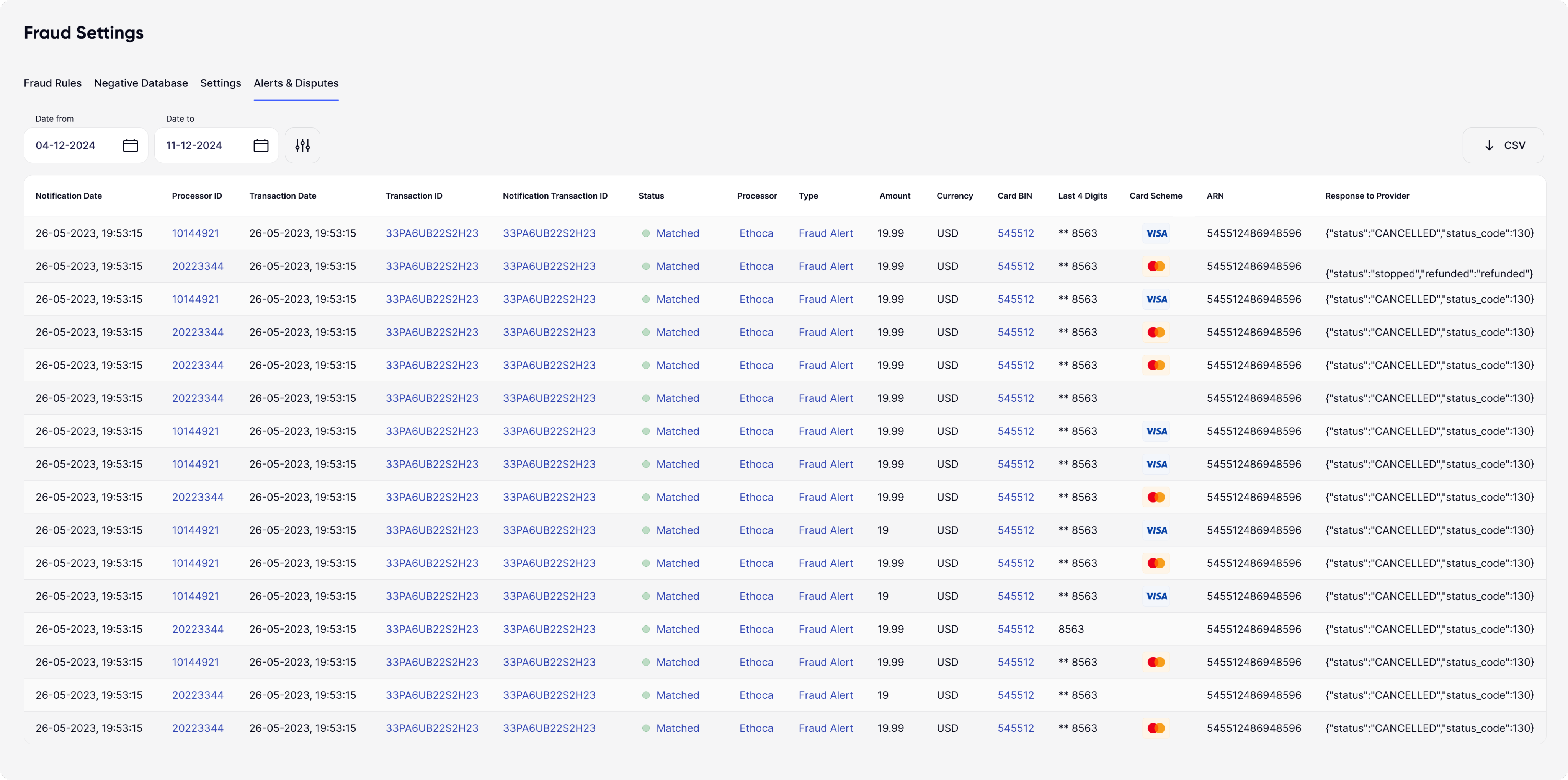
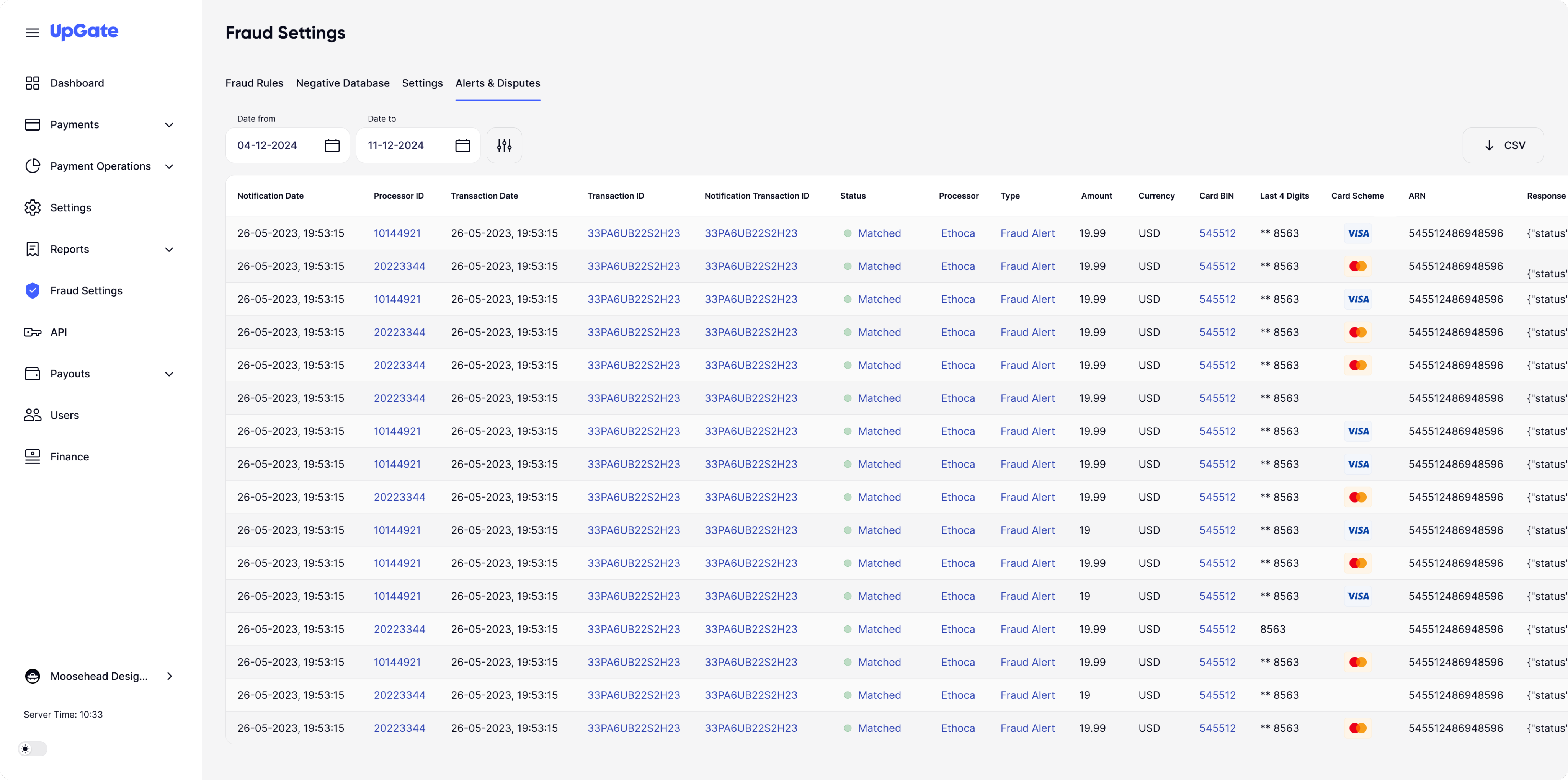
Through an integration powered by Verifi and Ethoca, UpGate receives pre-dispute scheme alerts indicating that a cardholder has flagged a transaction as suspicious — before a chargeback occurs.

FRAUD ALERTS

Scheme alerts provide early issuer insight, enabling proactive chargeback prevention

Merchants can configure automated responses, such as

  • Issuing an immediate refund
  • Blocking future attempts linked to the same identifiers
  • Updating the Negative Database

Automated Fraud & Dispute-Prevention Actions

All actions are evaluated pre-payment, ensuring the same behavior for every processor

UpGate allows merchants to define automatic actions triggered by

  • Fraud rule outcomes
  • Processor fraud alerts
  • Scheme alerts (Verifi/Ethoca)

Available automated actions include

  • Refunding suspicious transactions
  • Updating the Negative Database
  • Blocking transactions
  • Enforcing 3DS Challenge

Visa Rapid Dispute Resolution (RDR)

For merchants enrolled in Visa RDR, UpGate supports automated pre-chargeback case resolution

Merchants can define:

  • Which transactions should be automatically refunded
  • Which identifiers should be added to the Negative Database

Why UpGate's Architecture Is Different

Unlike processor-level fraud tools that operate independently, UpGate works across the entire orchestration layer. This ensures:

Unified Protection

One fraud strategy applied consistently to all processors

Shared Intelligence

Rules, alerts, and risk signals are applied globally — not in isolation

Cross-Processor Enforcement

A fraudster blocked once is blocked everywhere

Proactive Dispute Prevention

Scheme alerts allow action before a chargeback is initiated

Operational Efficiency

Automated refunds, blocks, and ND updates reduce manual work

Merchant Outcomes

  • Fewer chargebacks
  • Fewer repeated fraud attempts
  • More stable approval rates
  • Predictable and transparent risk management
  • One centralized dashboard for all fraud settings
  • Reduced operational overhead

Comparison Table — UpGate vs Payment Processors

Capability

Merchant-defined fraud rules

UpGate

Pre-routing rules based on country, BIN, IP, amount, email, etc

Payment Processors

Limited or unavailable; varies by processor

Capability

Negative Database

UpGate

Central high-risk identifier blocking across all processors

Payment Processors

Blocklists stored per processor; not shared

Capability

Rule-based 3DS triggering

UpGate

Merchant rules can enforce 3DS Challenge

Payment Processors

Supported but tied to processor-specific logic

Capability

Scheme fraud alerts (Visa/Mastercard)

UpGate

Integrated Verifi/Ethoca alerts with automation

Payment Processors

Some processors display alerts; limited automation

Capability

Auto-refund based on alerts

UpGate

Automatic refund + optional ND update

Payment Processors

Mostly manual; processor-dependent

Capability

Repeated offender blocking

UpGate

One ND entry blocks across all processors

Payment Processors

Must be blocked separately for each processor

Capability

Consistency of fraud decisions

UpGate

Same logic applied pre-routing

Payment Processors

Different logic per processor

Capability

Portability of fraud data

UpGate

ND, rules, alerts stay intact when switching processors

Payment Processors

Fraud data does not transfer

Capability

Dispute-prevention automation (RDR, alerts)

UpGate

Automated actions based on scheme signals

Payment Processors

Limited, typically reactive post-dispute

Capability

Configuration surface

UpGate

One dashboard for all fraud settings

Payment Processors

Multiple systems with separate configurations

Capability


Merchant-defined fraud rules

Negative Database

Rule-based 3DS triggering

Scheme fraud alerts (Visa/Mastercard)

Auto-refund based on alerts

Repeated offender blocking

Consistency of fraud decisions

Portability of fraud data

Dispute-prevention automation (RDR, alerts)

Configuration surface

UpGate


Pre-routing rules based on country, BIN, IP, amount, email, etc

Central high-risk identifier blocking across all processors

Merchant rules can enforce 3DS Challenge

Integrated Verifi/Ethoca alerts with automation

Automatic refund + optional ND update

One ND entry blocks across all processors

Same logic applied pre-routing

ND, rules, alerts stay intact when switching processors

Automated actions based on scheme signals

One dashboard for all fraud settings

Payment Processors


Limited or unavailable; varies by processor

Blocklists stored per processor; not shared

Supported but tied to processor-specific logic

Some processors display alerts; limited automation

Mostly manual; processor-dependent

Must be blocked separately for each processor

Different logic per processor

Fraud data does not transfer

Limited, typically reactive post-dispute

Multiple systems with separate configurations
Get started with Link
Request demo